
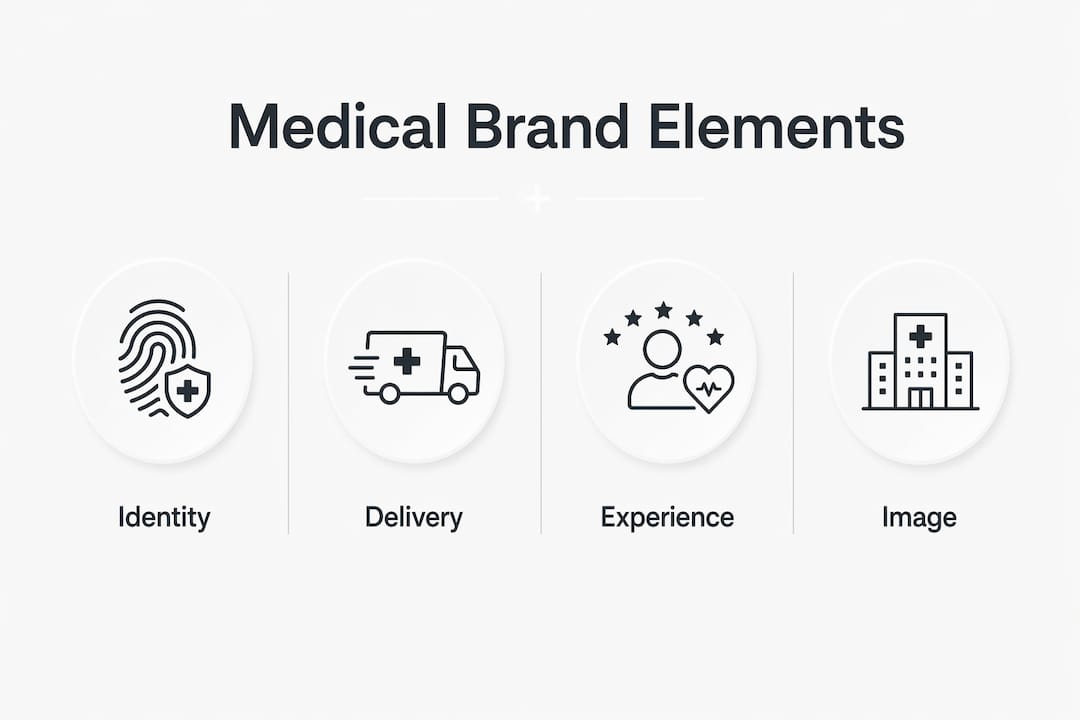
A medical personal brand is your unique professional identity expressed consistently across what you say, do, and how patients and peers perceive you in every clinical and digital interaction. Most physicians think of branding as marketing. It is not. According to research published in Academic Medicine, personal branding in medicine integrates four linked components: professional identity, delivery, experience, and image. Understanding how those four components work together is the starting point for any doctor who wants to build a reputation that actually reflects who they are, attract the right patients, and advance their career without burning out.
What is a medical personal brand and its key components?
A medical personal brand is built on four components that function as a feedback loop, not a checklist. Research from PubMed frames them as four questions every clinician must answer: Who am I professionally? What actions do I present? How are my actions experienced? How do others see me? Each question maps to a distinct component, and misalignment between components is the single most common cause of reputation drift, perceived disingenuousness, and clinician burnout.
Here is how each component works in practice:
- Brand identity. This is the foundation. Your values, clinical expertise, specialty focus, and the professional story you tell yourself. A cardiologist who values patient education and evidence-based care has a different identity than one who prioritizes procedural volume. Neither is wrong. Both need to be clearly defined before any outward communication begins.
- Brand delivery. This is every action and communication choice that expresses your identity. It includes how you speak to patients, what you publish, where you speak, and how your clinic’s front desk answers the phone. Delivery is the only component you fully control.
- Brand experience. This is how patients, colleagues, and employers actually experience your delivery. A physician who believes they communicate warmth but rushes through appointments creates a gap between delivery and experience. That gap is where trust erodes.
- Brand image. This is the cumulative perception others hold of you. It is shaped by Google search results, peer referrals, online reviews, and word of mouth. Image is the output of the entire system.
Pro Tip: Run a simple audit. Ask three colleagues and three patients to describe you in three words. Compare their answers to the three words you would use to describe yourself. The gaps you find are your brand alignment problem.
When all four components point in the same direction, your brand works without effort. When they diverge, energy drain and career stagnation follow. The London Business School frames this directly: personal branding in medicine is about clarifying identity and making career decisions that reduce burnout, not about building celebrity.

How to build a medical personal brand that actually works
Building a credible medical personal brand follows a specific sequence. Skipping steps produces a polished surface with no structural integrity underneath.
- Define your professional identity in writing. List your clinical specialty, your top three values, the patient population you serve best, and the one problem you solve better than most of your peers. This document becomes the filter for every brand decision you make afterward.
- Audit your current brand image. Search your name on Google. Read your reviews on Healthgrades, Zocdoc, and your hospital’s profile page. What you find is your current brand, regardless of what you intend it to be. Note the gaps between your identity document and what you find online.
- Build authority through recognized channels. According to Sermo, authority in medical branding comes from quality, evidence-based content shared through professional channels, not from posting frequency. Publishing in peer-reviewed journals, speaking at grand rounds, contributing to physician networks like Sermo or Doximity, and writing for patient-facing publications all carry more weight than daily social media posts.
- Create a consistent digital presence. Claim and complete your profiles on Google Business, Healthgrades, Doximity, LinkedIn, and any specialty-specific directories. Use the same professional photo, the same bio language, and the same specialty focus across all platforms. Consistency signals credibility to both patients and search algorithms.
- Differentiate within your specialty. Patients searching for a dentist in Yonkers or a cardiologist in Chicago have dozens of options. Your brand must answer the question: why you, specifically? Dr. Amit Rajani at Yonkers Avenue Dental, for example, differentiates through patient education content that addresses anxiety around dental procedures. That specific focus attracts a specific patient who is already pre-sold before the first appointment.
- Maintain authenticity in every communication. Patients and peers detect inauthenticity quickly. Your brand delivery must match your actual clinical behavior. If you brand yourself as a compassionate communicator, that standard applies in every patient interaction, every staff meeting, and every social media comment.
Pro Tip: Do not try to build your brand everywhere at once. Pick one primary platform where your patients actually spend time, execute there consistently for 90 days, then expand. Doctors who try to be on YouTube, Instagram, LinkedIn, and TikTok simultaneously produce mediocre content on all four.
Why digital visibility defines your medical professional reputation
Digital visibility is now the first point of contact between a physician and a prospective patient. Online presence drives trust, referrals, and competitive positioning before any clinical interaction occurs. A patient who cannot find you online, or who finds outdated or inconsistent information, will choose someone else. That is not a marketing problem. It is a brand delivery failure.
Managing your digital footprint requires attention to several distinct channels:
| Channel | Primary function | Key action |
|---|---|---|
| Google Business Profile | Local search visibility | Claim, verify, and update with current hours and specialty |
| Healthgrades / Zocdoc | Patient review and discovery | Respond to reviews professionally and promptly |
| Doximity / LinkedIn | Peer referral and professional credibility | Publish articles and maintain an updated specialty profile |
| Practice website | Brand hub and patient conversion | Include a clear bio, patient testimonials, and a booking link |
| Instagram / YouTube | Patient education and trust building | Share condition-specific content aligned with your specialty |
The risk in digital visibility is overreach. Ethical language and transparency are not optional guardrails. They are core brand signals. A physician who claims to be “the best” in their specialty without substantiation, or who shares patient outcomes without explicit consent, damages their brand image faster than any competitor could.
Doctors working with Prime Craft Media on social media production consistently report that a structured content presence, built around their actual expertise, generates inbound consult requests without requiring them to post daily or manage content themselves.
Common challenges and ethical considerations in medical branding
Medical branding carries risks that do not exist in other industries. The stakes are higher because the product is healthcare, and the audience is vulnerable. Ethical compliance is foundational, not an afterthought. It influences patient trust and regulatory standing simultaneously.
The most common pitfalls physicians encounter include:
- Exaggerated claims. Describing yourself as “top-rated” or “leading expert” without verifiable evidence violates both ethical standards and FTC guidelines. Patients are increasingly skeptical of superlatives. Specific, verifiable credentials carry more weight.
- Patient privacy violations. Sharing before-and-after photos, case details, or patient testimonials without written, HIPAA-compliant consent is a legal and ethical breach. It also destroys the trust your brand is designed to build.
- Brand misalignment. When what you communicate publicly does not match how patients experience your care, the resulting reputation drift is difficult to reverse. Misalignment also contributes directly to clinician burnout, as the energy required to maintain a false image compounds over time.
- Lack of transparent identification. Any digital content you produce must clearly identify you as a physician and disclose any commercial relationships. Ambiguity about your role or affiliations erodes credibility.
“Medical personal branding is not self-promotion. It is identity exploration that helps clinicians navigate reputation and career pathways with clarity and purpose.” PubMed, Academic Medicine
Ethical guardrails in digital medical branding include avoiding exaggerated claims, securing patient consent for any patient-related content, and maintaining transparent physician identification across all platforms. These are not restrictions on your brand. They are the architecture that makes your brand trustworthy.
Key takeaways
A medical personal brand succeeds when professional identity, delivery, experience, and image are aligned, ethical, and consistently expressed across every clinical and digital touchpoint.
| Point | Details |
|---|---|
| Four-component framework | Identity, delivery, experience, and image must align to build a credible medical brand. |
| Misalignment causes burnout | Gaps between what you communicate and how others experience it drain energy and damage reputation. |
| Authority over frequency | Publishing and speaking in recognized channels builds more brand equity than daily social posts. |
| Digital visibility is non-negotiable | Patients encounter you online before they meet you; your profiles must reflect your actual brand. |
| Ethics are a brand signal | Truthful messaging, patient consent, and transparent identification directly influence patient trust. |
Why brand alignment matters more than brand visibility
I have worked with enough doctors to say this plainly: most physicians who come to us do not have a visibility problem. They have an alignment problem. They are posting content that does not reflect how they actually practice. They are showing up online as one version of themselves and delivering a different version in the clinic. Patients notice. Colleagues notice. And eventually, the physician notices too, usually in the form of exhaustion.
The research from London Business School confirms what I see in practice: personal branding reduces burnout when it is grounded in genuine identity work, not performance. The doctors I have seen build the most durable brands, people like Dr. Naved Fatmi and Dr. Mershad, did not start by asking “what should I post?” They started by asking “what do I actually stand for, and who do I serve best?”
Digital tools, content systems, and social media production are only as good as the identity work underneath them. A one-day shoot can produce six months of content. But if that content does not reflect who you genuinely are as a clinician, it will feel hollow to the people watching it, and it will feel hollow to you. Start with the identity. Build the content system on top of it. That sequence is the one that holds.
Sajal
How Prime Craft Media helps doctors build their personal brand
Prime Craft Media builds done-for-you content systems specifically for doctors, DSOs, and healthcare brands. The core model is a single production day that generates an ongoing, AI-assisted content library, so you never have to film again. Services cover social media production, AI avatar production for scale and multilingual content, YouTube strategy, podcast growth, video editing, and patient acquisition funnels built on Meta and GHL.
Doctors who want to translate their professional identity into a consistent, visible, and ethical brand can explore the personal branding services Prime Craft Media offers for healthcare professionals. For those who want to understand the production methodology behind the content system, the Prime Craft approach explains exactly how it works and what to expect.
FAQ
What is a medical personal brand in simple terms?
A medical personal brand is the professional identity a physician intentionally defines and communicates through their actions, content, and clinical behavior. It shapes how patients, colleagues, and employers perceive and trust them.
How is a medical personal brand different from regular marketing?
Medical personal branding focuses on clarifying professional identity rather than promoting services. Research from PubMed describes it as an identity exploration process that helps clinicians navigate career decisions and reputation, not a sales tool.
What are the key elements of a strong medical brand?
The four key elements are brand identity, brand delivery, brand experience, and brand image. Alignment across all four produces a credible, trusted reputation. Misalignment produces reputation drift and clinician burnout.
How do doctors build authority through personal branding?
According to Sermo, authority in medical branding comes from publishing evidence-based content, speaking in professional settings, and maintaining a presence on recognized physician networks like Doximity, not from posting volume.
What ethical rules apply to medical personal branding?
Physicians must avoid exaggerated claims, obtain HIPAA-compliant patient consent before sharing any patient-related content, and clearly identify themselves as physicians in all digital communications. These standards protect both patients and the physician’s professional standing.